 Course Duration: 5 days, including lecture-based modules and hands-on exercises
Who Should Attend: Development and exploration geologists, petrophysicists, log and core analysts, geophysicists, petroleum engineers, managers, and technical personnel
Course Summary: Petrophysics remains a vital component to many facets of the petroleum industry, from quantification of hydrocarbon reserves to developmental strategies to real-time decision making for reservoir navigation. This course addresses the fundamental tenets of petrophysics and formation evaluation, using integrative perspective of multiple datasets, including geological, geophysical, and logging and core data. Significant worldwide case histories are included, as well as several exercises designed to provide hands-on experience.
You Will Learn How To:
- Understand better the latest geological, geophysical, and logging/core technologies and their role in petrophysical analysis, formation evaluation, and reservoir characterization.
- Address the pros and cons of key datasets, with emphasis on need for integrative studies and calibration of datasets.
- Apply quick-look qualitative techniques as well as quantitative aspects to understand vital aspects such as volume of shale/clay, porosity, permeability, and water saturation determinations.
- Select tool combinations to resolve key issues and for specific applications.
- Assess uncertainty in petrophysical measurements and techniques and its influence on reserve estimation.
Course Topics:
- Welcome and Introduction
- Discussion of the “need” for petrophysical analysis and formation evaluation, including integrated core and log analysis with worldwide case examples, illustrating their importance to hydrocarbon exploration and production.
- Rock and Fluid Properties
- Classification and identification of clastic and chemical sedimentary rocks
- Impact of weathering, burial, and lithification on sedimentary rocks
- Cement types and origin
- Porosity and permeability
- Flow anisotropy and well placement (exercise)
- Impact of grain arrangements, matrix materials, and fluid types
- Water saturation determination (basic Archie analysis and complex modifications)
- Pressure analysis
- Aspects of Drilling and Logging
- Mud logging
- Core acquisition and interpretation
- Wireline and LWD logging and imaging
- Analogue studies
- Well correlation (exercise)
- Core and Log Analysis
- Gamma ray log analysis, including spectral GR
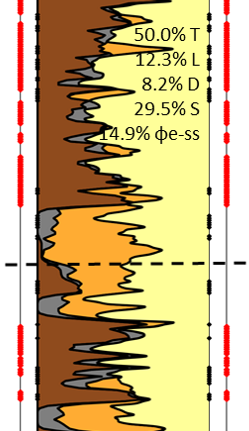
- Volume of shale (Vsh) analysis (exercise)
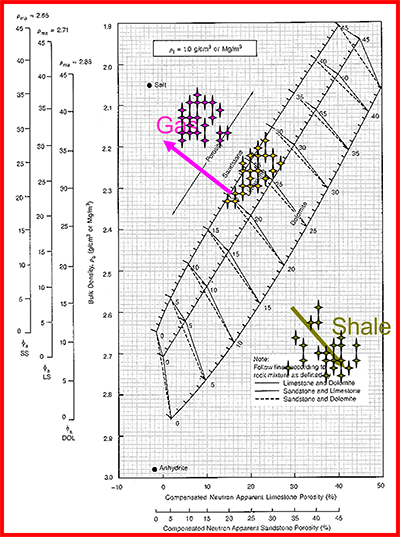
- Porosity log analysis (density, neutron porosity, and sonic)
- Lithologic determination (exercise)
- Resistivity log analysis and water saturation
- Water saturation (Sw) determination (exercise)
- Clay conductivity and Sw (exercise)
- Acoustic log analysis (compressional, shear, and Stoneley waves)
- Porosity and bulk volume hydrocarbons (exercise)
- Gamma ray log analysis, including spectral GR
- Nuclear magnetic resonance
- Hydrocarbon and water typing (exercise)
- Azimuthal (image) log analysis
- Dip determination (exercise)
- Calibration of core and log data
- Nuclear magnetic resonance
- Seismic Petrophysics
- Seismic versus log comparison and data integration
- Seismic attribute analysis
- Bright, dim, and flat spots; amplitude versus offset/angle analysis; zero- and 90-degree phase
- Attribute analysis (exercise)
- Summary and Concluding Remarks
- The present state and future role of petrophysical analysis and formation analysis.